

Palmitoyl Chloride
General Information
Chemical Structure
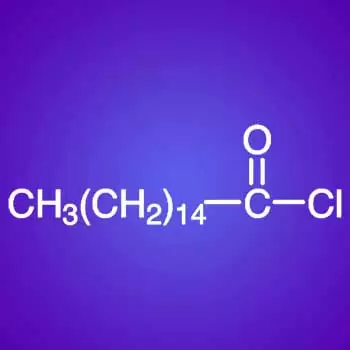
Basic Details
Physical Properties
Applications & Grade
Palmitoyl Chloride is a highly versatile acyl chloride extensively used as a key intermediate in the pharmaceutical industry for the synthesis of various active pharmaceutical ingredients (APIs) and their derivatives.
- Chloramphenicol Palmitate: Palmitoyl chloride is used to esterify chloramphenicol, forming chloramphenicol palmitate. This derivative is often preferred for oral suspensions due to its reduced bitterness, and it is hydrolyzed in the body to release the active chloramphenicol.
- Nateglinide: While direct synthesis with palmitoyl chloride is less common, it can be involved in acylation steps or derivatization within complex synthetic routes for Nateglinide, an oral antidiabetic drug.
- Paliperidone Palmitate: Palmitoyl chloride is a critical reagent in the esterification of paliperidone to form paliperidone palmitate, a long-acting injectable antipsychotic used in the treatment of schizophrenia.
- Clindamycin Palmitate HCl: It is used in the synthesis of clindamycin palmitate hydrochloride, an ester prodrug of clindamycin, which is used in pediatric formulations due to its improved taste and is hydrolyzed in vivo to the active antibiotic.
- Ascorbyl Palmitate Intermediate (Vitamin C): Palmitoyl chloride reacts with L-ascorbic acid (Vitamin C) to form Ascorbyl Palmitate, a fat-soluble form of Vitamin C used as an antioxidant in food and cosmetic products. This enhances the stability and penetration of Vitamin C.
Beyond pharmaceuticals, Palmitoyl Chloride has diverse applications in various industrial sectors:
- Surfactant Production: Key ingredient in the formulation of surfactants, emulsifiers, and skin-conditioning agents for cosmetic and personal care products.
- Bioconjugation: Employed in biochemistry for attaching palmitic acid to proteins or peptides to enhance their stability and cellular uptake.
- Polymer Chemistry: Utilized in the production of specialty polymers to provide increased hydrophobicity and thermal stability.
- Research & Development: A common reagent in organic synthesis for introducing long-chain fatty acyl groups.
Our Palmitoyl Chloride is primarily offered as **Pharma Grade**, ensuring it meets the stringent purity and quality standards required for pharmaceutical synthesis and drug manufacturing.
Product Specifications
| Tests | Specification |
|---|---|
| Description | Clear colorless to straw yellow colored liquid |
| Solubility | Soluble in Acetone and Ether |
| Wt. per ml in gm/ml @ 25°C | Between 0.89 to 0.90 |
| % Area by G.C. of its Methyl Ester (Palmitoyl chloride) |
Not less than 99.0% |
Certificate of Analysis
(Hexadecanoyl Chloride)
Description
Specification: Clear colorless to light yellow colored liquid
Result: Complies
Solubility
Specification: Soluble in Acetone and Ether
Result: Complies
Wt. per ml in gm/ml @ 25°C
Specification: Between 0.89 to 0.90
Result: 0.897
% Area by G.C. of its Methyl Ester
(Palmitoyl chloride)
Specification: Not less than 99.0%
Result: 99.60%
Spectroscopic Analysis
Packaging, Handling & Storage
Packaging
- Typically supplied in sealed, moisture-proof containers such as glass bottles, plastic-coated metal drums, or specialized chemical containers.
- Available in various sizes, from laboratory quantities (e.g., 25ml, 100ml, 500ml) to bulk industrial quantities (e.g., 25kg, 200kg drums).
- Containers are designed to protect the product from moisture, light, and contamination, ensuring its stability and purity.
Handling
- Handle in a well-ventilated area or under a fume hood due to its corrosive and moisture-sensitive nature.
- Avoid direct contact with skin, eyes, and clothing. Causes severe burns.
- Wear appropriate personal protective equipment (PPE): chemical-resistant gloves (e.g., butyl rubber, Viton), safety goggles/face shield, and protective clothing.
- Avoid breathing dust/fume/gas/mist/vapors/spray.
- Reacts violently with water; avoid contact with water during handling.
- Wash thoroughly after handling.
Storage
- Store in a cool, dry, and well-ventilated place.
- Keep containers tightly closed and sealed, preferably under nitrogen or in an inert atmosphere, protected from moisture and direct sunlight.
- Store away from incompatible materials (e.g., water, strong bases, alcohols, amines, metals, strong oxidizing agents).
- Recommended storage temperature: +4°C or as specified by the supplier.
- Ensure containers are clearly labeled.
Safety & Regulations
This section provides essential safety and regulatory information for **Palmitoyl Chloride, CAS No. 112-67-4**. It is crucial to handle this chemical with appropriate precautions and in accordance with all applicable local, national, and international regulations.
Product Identification
GHS Classification
This product is classified according to the Globally Harmonized System of Classification and Labelling of Chemicals (GHS).
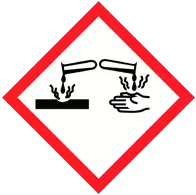
Corrosion
Hazard Statements (H-codes):
- H314: Causes severe skin burns and eye damage.
- EUH014: Reacts violently with water.
Precautionary Statements (P-codes):
- P260: Do not breathe dust/fume/gas/mist/vapors/spray.
- P264: Wash skin thoroughly after handling.
- P280: Wear protective gloves/protective clothing/eye protection/face protection.
- P301+P330+P331: IF SWALLOWED: Rinse mouth. Do NOT induce vomiting.
- P303+P361+P353: IF ON SKIN (or hair): Take off immediately all contaminated clothing. Rinse skin with water/shower.
- P304+P340: IF INHALED: Remove person to fresh air and keep comfortable for breathing.
- P305+P351+P338: IF IN EYES: Rinse cautiously with water for several minutes. Remove contact lenses, if present and easy to do. Continue rinsing.
- P310: Immediately call a POISON CENTER or doctor/physician.
- P363: Wash contaminated clothing before reuse.
- P405: Store locked up.
- P501: Dispose of contents/container to an approved waste disposal plant.
Transport Information (UN Model Regulations)
(Palmitoyl chloride)
Downloads
Safety Data Sheet (SDS)
Comprehensive safety information for handling and storage of Palmitoyl Chloride.
Certificate of Analysis (COA)
Batch-specific analytical results and quality assurance for Palmitoyl Chloride.
Technical Data Sheet (TDS)
Detailed product specifications and typical properties for Palmitoyl Chloride.
Chromatogram Data
Full HPLC/GC chromatogram and peak analysis report (Coming Soon).